
Garage Door Spring Repair in Spokane, WA
If your garage door will not lift, feels extremely heavy, or you heard a loud bang from the garage, a broken spring is the most likely cause. Do not try to force the door open. Spokane Garage Door Repair is a referral service. We connect you with local providers who replace broken springs safely, and you can request service through our contact form.
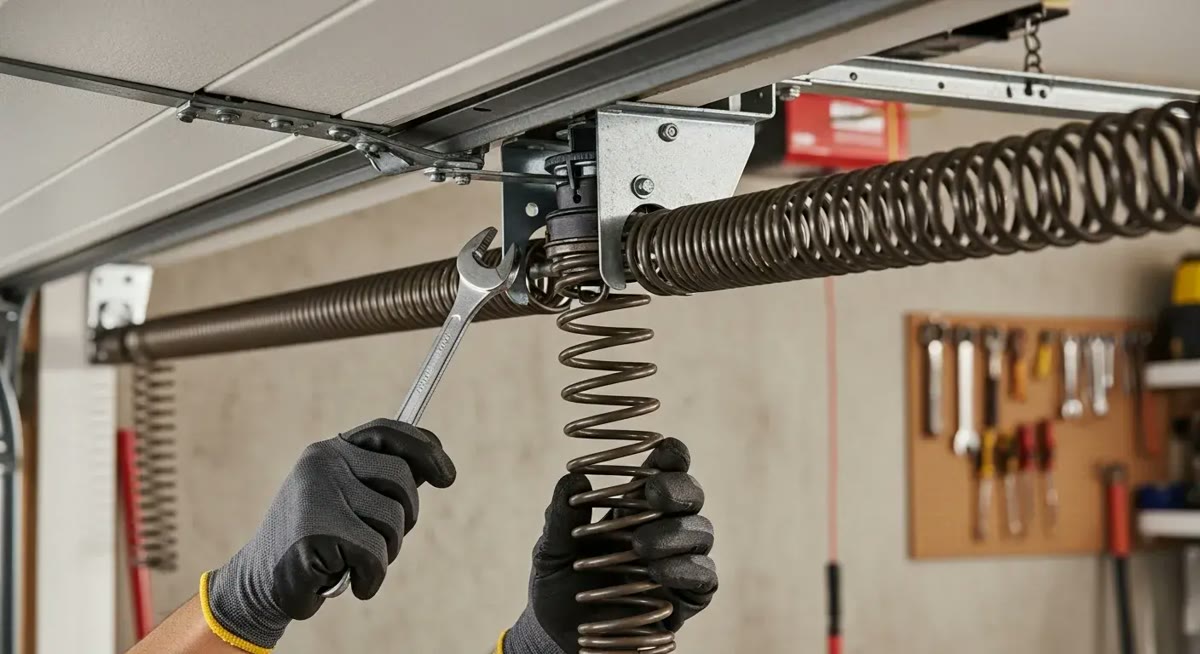
What do garage door springs actually do?
Garage door springs do the heavy lifting. A typical residential door weighs far more than most people expect, and the springs counterbalance that weight so the door can be raised by hand or by a modest electric opener. When the springs are working correctly, the door should feel almost balanced at every point in its travel. It should stay in place when left halfway open, rise without straining, and close without slamming. When a spring weakens or breaks, that balance disappears all at once.
There are two main spring systems used on homes in the Spokane area. Torsion springs sit on a metal shaft mounted on the wall above the door opening. They work by twisting, and that stored twisting force helps lift the door through cables attached to the bottom corners. Extension springs run along the horizontal tracks on either side of the door, or above those tracks, and they work by stretching as the door closes and contracting as it opens. Extension systems should always have safety cables running through the springs so that a broken spring is contained rather than flying loose.
The type fitted to your door matters for repair. Torsion and extension springs are not interchangeable, they come in different sizes and strengths, and the correct spring depends on the weight, height, and design of your specific door. Fitting the wrong spring can leave the door unbalanced, strain the opener, and wear out cables and rollers early. That is one reason a provider measures and weighs the door rather than guessing from appearance alone.
What are the signs of a broken garage door spring?
Spring failure is often sudden, but there are usually clues in the days before it snaps. Recognizing the signs helps you stop using the door before a small problem turns into damage to the opener or the door itself. Common signs include the following.
- A loud bang from the garage, often described as sounding like a gunshot or a firecracker, when the coil snaps under tension.
- The door feels extremely heavy when you try the manual release, or it will not lift more than a few inches.
- A visible gap in the coil of the torsion spring above the door, where the once tight coil has separated.
- The opener runs and strains but the door barely moves, or the top panel starts to bend as the opener pulls.
- The door rises a short distance, then stops, drops, or comes down crooked.
- The door had been getting noisier, slower, or harder to lift by hand in the weeks before it failed.
If you see a gap in the coil, the diagnosis is clear and no further testing is needed. Leave the door closed and make a request. If you are starting your search with broader garage door repair in Spokane, this page explains the spring specific problem in detail so you can describe it accurately when you contact us.
Why is spring replacement dangerous to do yourself?
This is the most important safety point on this page. Garage door springs are under high tension at all times, even when the door is closed. A torsion spring stores enough energy to lift a very heavy door, and that energy has to go somewhere when parts are loosened. Winding bars can slip, a spring can unwind in an instant, and extension springs can snap and whip across the garage. Injuries from do it yourself spring work are well documented and can be severe, including broken bones and deep cuts.
Professional providers use the correct winding bars, secure the door before starting, release tension in a controlled way, and know how much tension a given door needs. They also check the shaft, bearings, and drums while tension is off. Without training and the right tools, there is no safe shortcut. Do not stand in line with a spring while adjusting it, do not use screwdrivers in place of winding bars, and do not loosen the red painted hardware on the spring system. Those parts are under load even when nothing appears to be moving.
For the same reason, stop using the opener once you suspect a broken spring. An opener is designed to move a balanced door, not to dead lift an unbalanced one. Repeated attempts can strip gears inside the opener, burn out the motor, or pull the top panel out of shape, adding a second repair on top of the first.
What does a provider do during spring replacement?
A typical spring replacement visit follows a clear sequence. First, the provider confirms the failure and identifies the spring system, then measures the existing spring, including wire size, coil diameter, and length, and confirms the weight of the door. Next, the door is secured and tension is released in a controlled manner. The broken spring is removed from the shaft or track mounts, and the new spring or pair of springs is fitted.
Once the new springs are wound to the correct tension, the provider tests the balance of the door by hand. A well balanced door should lift smoothly, stay where it is left, and not drift up or down on its own. The provider will usually also inspect related parts while the system is apart, because worn parts often contribute to each other. That inspection commonly covers the lifting cables, the cable drums, the center and end bearings, and the rollers. If a cable is frayed, it is far better to learn that now than after a second failure. You can read more about that related work on our garage door cable repair page.
Finally, the opener is reconnected and its travel and force settings are checked against the newly balanced door. The provider will run the door through several full cycles and confirm the safety reversal systems respond correctly before leaving.
Why do Spokane winters wear springs out faster?
Cold weather is hard on springs. Metal becomes less flexible as temperatures fall, so a coil that flexes thousands of times over its life is under extra stress on a freezing morning. Lubricant on the spring and in the bearings can thicken in the cold, which adds resistance every time the door moves. Freeze and thaw cycles around the bottom seal can also make the door stick slightly to the floor, so the first lift of the day asks the spring and opener to work harder than usual.
Spokane winters bring sustained cold rather than a single cold snap, and that matters for fatigue. A spring does not usually break because of one hard day. It breaks because metal fatigue has built up over many cycles, and cold conditions push an already tired spring past its limit. This is why so many spring failures happen first thing on a winter morning, when the door has sat closed and cold all night and the spring is at its stiffest.
You cannot stop winter, but you can reduce the strain. Keep the spring lightly lubricated with a product made for garage doors, keep tracks clear of packed snow and ice, and avoid forcing a door that is frozen to the floor. If the door sounds strained or uneven in cold weather, that is worth mentioning in your request rather than waiting for a full break.
What affects the cost of spring repair?
We do not publish prices, because the cost depends on your door and on the local provider who does the work. The main factors are straightforward. Spring type is one factor, since torsion and extension systems use different parts and different labor. Door size and weight is another, because larger and heavier doors, including insulated doors, need stronger springs. Whether you have a single spring or a pair also matters, as does whether both springs are replaced together.
Related wear can affect the total as well. If cables, bearings, or drums are worn, a provider may recommend replacing them during the same visit, and will explain that before doing the work. The provider who is matched with your request will give you a quote for your specific door. Submitting the form costs you nothing and lets you describe the problem in your own words, including any of the signs listed above.
How does our referral service work for spring repair?
Our process has three simple steps. First, you describe your issue using the form on our contact page. Mention the loud bang, the visible gap in the coil, or the fact that the door will not lift, and say whether your car is inside the garage. Second, we review your request and try to match it with a local provider that handles spring replacement in the Spokane area. Third, the provider contacts you, discusses timing, and handles the job directly if you choose to go ahead.
We do not perform garage door work ourselves, and providers in our network may include licensed professionals. Depending on availability, you may be connected with a highly rated local provider. If your door is stuck partly open, your car is trapped, or the problem feels urgent, say so clearly in the form. In those cases our emergency garage door repair page explains what to do while you wait and how urgent requests are handled.
Frequently Asked Questions
No. Without a working spring the door is extremely heavy and the opener is not designed to lift that full weight. Trying to open it can damage the opener, bend tracks, or cause the door to fall. Keep the door closed and wait for a provider.
If your door has two springs, they were usually installed together and have worn at a similar rate. Many providers recommend replacing both so the door stays balanced and you are less likely to face a second failure soon after the first.
Springs are rated in cycles, and one cycle is one full opening and closing. A higher cycle rating generally means a longer expected service life, but actual life depends on how often the door is used, door weight, maintenance, and weather. A provider can explain the rating of the replacement spring being fitted.
A snapped spring cannot be safely repaired or welded back together. Once a coil breaks, the spring has lost its strength and the correct fix is replacement with a spring matched to the weight and size of your door.
Treat it as urgent if your car is trapped inside, the door is stuck partly open, or the door will not close and your home is unsecured. Even when it is less urgent, the door should not be used until the spring is replaced.
Cold makes metal more brittle and less flexible, and thickened lubricant can add resistance as the door moves. In Spokane winters an older spring that was already near the end of its cycle life is more likely to fail on a cold morning.
Tell us whether you heard a loud bang, whether the door will lift at all, whether you can see a gap in the coil above the door, and whether your car is trapped inside. That detail helps us match your request with a provider that handles spring work.
Ready to request spring repair?
Tell us what your door is doing and we will try to match your request with a local provider serving the Spokane area. The sooner you stop using a door with a broken spring, the less chance there is of extra damage to the opener or panels.